It is mid-2026, and if you listen carefully, you can hear the collective sigh of a million marketing managers. The internet has become a crowded party where everyone is shouting through a megaphone powered by AI, and frankly, nobody is listening.
For years, the received wisdom has been that “more is more.” More content, more platforms, more emails, more automation. But here is the cold, hard truth: the more you do, the less anyone cares. We have reached peak fluff. If your current marketing strategies for a website involve throwing everything at the wall to see what sticks, you are not just wasting time — you are actively alienating your future customers.
At Zest City, a UK digital agency specialising in website marketing, SEO, and digital strategy for businesses across Kent and Essex, we have spent the past year watching the landscape shift in real time. The winners in 2026 are not the ones with the biggest budgets or the loudest bots. They are the ones who have embraced a leaner, sharper philosophy: Do Less, Better.
This guide breaks down exactly what that means in practice — and how you can apply it to your own website marketing strategy right now.
The Burnout of “More”
You know the feeling. You check the analytics at 8am, and despite posting three times a day and running five different ad campaigns, your conversion rate is flatter than a Monday morning meeting. Something is wrong, but you cannot quite name it.

The problem is performative marketing: doing things simply to look busy, rather than to achieve something specific. We have replaced actual strategy with a frantic checklist. We are so busy “doing” marketing that we have forgotten why we are doing it in the first place.
In 2026, your audience is sharper than ever. They can spot AI-generated filler content from a mile away. They are weary of fragmented brand experiences and hollow promises. To win now, you need to stop acting like a content factory and start acting like a thoughtful curator.
1. Structure Over Tactics
Most businesses start with the “what.” What if we did a podcast? What if we tried TikTok? What if we ran a giveaway?
Stop.
The most effective marketing strategies for a website start with the “why” and the “how.” You need a structure — a strategic framework — not a shopping list of tools and platforms. Before you spend a single penny on digital media campaigns, define one primary goal. Just one.
- Is it high-quality lead generation?
- Is it building brand authority in your sector?
- Is it improving customer retention?
When you have a single, clearly defined goal, every decision becomes straightforward. If a tactic does not serve that goal, it goes in the bin. This clarity also creates psychological safety for your team: removing the pressure to be everywhere at once frees them to be genuinely excellent at the one thing that actually moves the needle.
2. Mastery Over Presence — The Power of Two
There is a persistent myth that your business must maintain an active presence on every platform. In 2026, being “everywhere” almost always means being “mediocre everywhere.”
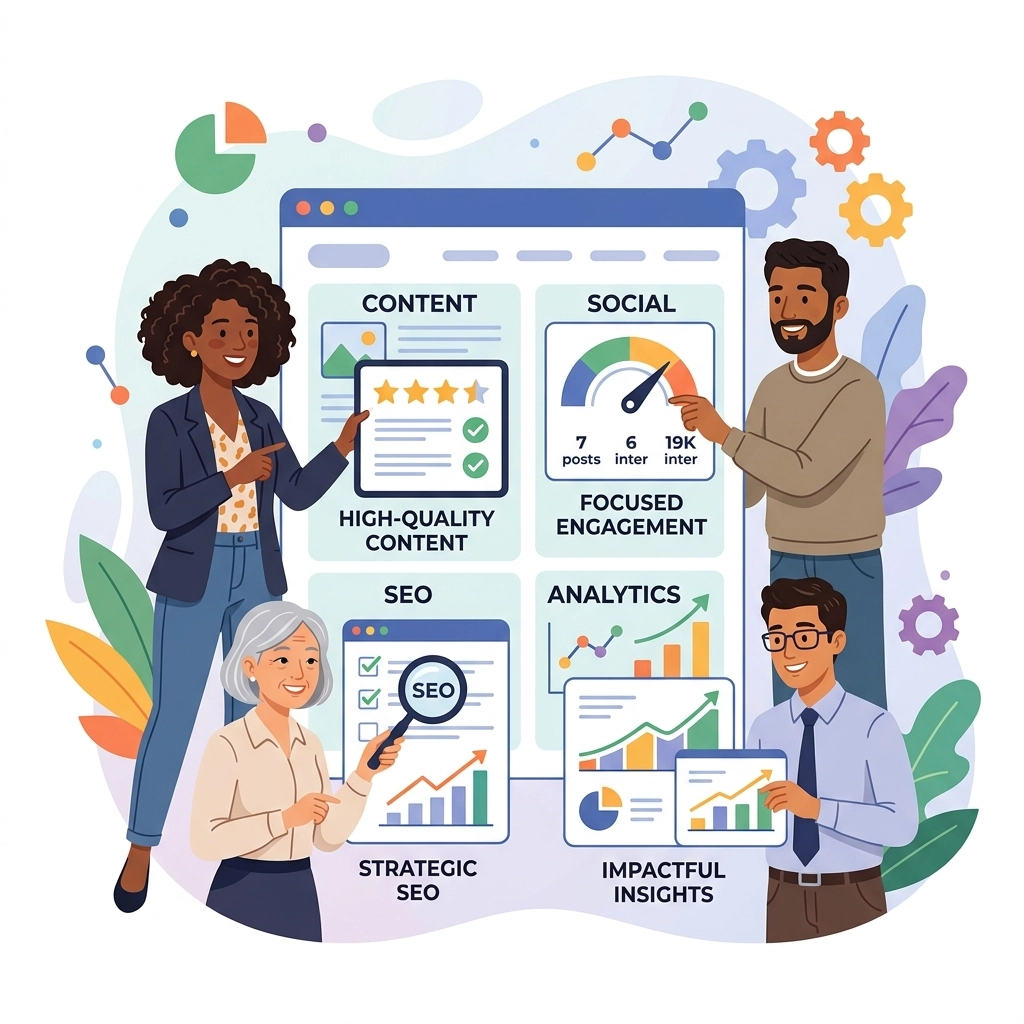
The Do Less, Better approach means picking two primary channels and mastering them completely. For some businesses, that might be organic SEO paired with social media marketing. For others, it could be high-value webinars supported by a focused email newsletter. The combination matters less than the commitment to depth over breadth.

Mastery means understanding the nuance of a platform rather than simply broadcasting into it. It means building genuine community. And it means looking honestly at your data and acknowledging that 80% of your results come from 20% of your efforts — then having the discipline to stop pouring energy into the other 80%.
When we look at successful client case studies here at Zest City, focus beats fragmentation every single time. A cohesive customer journey that feels like a conversation consistently outperforms a scattergun series of disconnected adverts.
3. Human-First Content in an AI World
Let us be absolutely clear: AI is a tool, not a strategy. In 2026, the most valuable currency in digital marketing is trust. Because anyone can now generate a thousand words of “best practice” content in ten seconds, the value of generic content has collapsed to near zero.
What cannot be faked? Real-world experience, genuine expertise, and an authentic voice.
Your marketing strategies for a website must prioritise content that demonstrates these qualities:
- Case studies: Show, do not tell. Concrete evidence of results is worth more than any amount of aspirational copy.
- Original research and data: What does your business know that nobody else does? That proprietary insight is gold.
- A distinctive voice: Stop writing like a corporate manual. Write like a knowledgeable human being who actually cares about the reader’s problem.
If your website content reads as though it was written by a committee of robots, do not be surprised when your bounce rate looks like a ski slope. Zest City’s website marketing services are specifically designed to inject personality, authority, and strategic purpose back into your brand’s online presence.
4. The End of the Third-Party Cookie — Own Your Data
By now, the cookie apocalypse is well and truly behind us. In 2026, if you do not own your data, you do not fully own your marketing.
The Do Less, Better approach means abandoning the chase for vanity traffic and focusing instead on building a high-quality, first-party data set. In practical terms, this means:
- Permission-based marketing: Getting people to want to hear from you, rather than interrupting them.
- High-value lead magnets: Offering something genuinely useful — a guide, a tool, a report — that people are happy to exchange their contact details for.
- Your website as a community hub: Treating your site as a destination and a resource, not merely a digital brochure.

When you have a direct, permission-based line to your customers, you are no longer at the mercy of the latest algorithm update from Google or Meta. You have a stable, owned foundation — and that is an enormous competitive advantage.
5. Integrating the Experience
Fragmentation is the enemy of conversion. If your social media presence feels like a completely different brand from your website, you are losing people in the gaps between touchpoints.
A Do Less, Better blueprint ensures that every single touchpoint is coherent and connected. Your website marketing strategy should deliver a seamless, intuitive experience that is focused on the user’s needs — not on demonstrating how busy your marketing department is.

Think of content as a system rather than a series of isolated outputs. One piece of genuinely high-quality content — say, a detailed industry report — should fuel five social posts, three email segments, and a short video. That is the real meaning of “do more with less.” It is strategic efficiency at its most powerful.
This integrated approach also applies to your visual identity. If your brand looks inconsistent across channels, it undermines trust before a single word is read. Zest City’s corporate identity design services ensure your brand presents a unified, professional face wherever your customers encounter you.
6. Measuring Outcomes, Not Activities
Finally — and this is critical — we need to change how we define success. Stop leading with impressions. Impressions are the equivalent of people walking past your shop window with their eyes closed.
In 2026, the metrics that actually matter are:
- Qualified lead volume: Are the right people getting in touch?
- Conversion rate by channel: Which of your two chosen channels is actually producing revenue?
- Customer lifetime value (CLV): Are you attracting customers who stay, buy again, and refer others?
- Cost per acquisition (CPA): What does it actually cost you to win a customer through each activity?
- Engagement depth: Are people reading your content, returning to your site, and signing up for more?
If you cannot draw a straight line from a marketing activity to revenue or a clearly defined business outcome, it is worth questioning why you are doing it at all.
Putting It All Together: Your 2026 Action Plan
Here is a practical summary of the Do Less, Better framework for your website marketing strategy this year:
- Define one primary goal and filter every decision through it.
- Choose two channels and commit to genuine mastery of both.
- Create human-first content rooted in real experience, genuine data, and an authentic voice.
- Build your first-party data asset through permission-based, value-led marketing.
- Integrate every touchpoint so that your brand experience is seamless from first click to conversion.
- Measure what matters — outcomes and revenue, not vanity metrics.
Zest City works with businesses across Kent, Essex, and the wider UK to build focused, effective digital marketing strategies that cut through the noise. If your current approach feels exhausting and is delivering diminishing returns, it may be time for a strategic reset.
Ready to market smarter, not harder?
Zest City offers a free digital audit for businesses in Kent and Essex — we will review your current website marketing strategy and identify exactly where you can do less and achieve more. No obligation, no jargon.
Frequently Asked Questions: Marketing Strategies for a Website in 2026
What are the most effective marketing strategies for a website in 2026?
The most effective website marketing strategies in 2026 focus on depth over breadth. This means choosing one or two channels and mastering them, creating genuinely useful human-first content, building first-party data through permission-based marketing, and measuring outcomes rather than vanity metrics like impressions. The “Do Less, Better” approach — defining a single primary goal and aligning all activity with it — consistently outperforms scattered, high-volume tactics.
How many marketing channels should a small business focus on?
Most small and medium-sized businesses will see better results by focusing on two primary marketing channels rather than attempting to maintain a presence across five or more. Mastering two channels — understanding their nuances, building genuine community, and consistently delivering value — produces far stronger returns than spreading effort t