The digital landscape has changed more in the last two years than in the previous decade. By mid-2026, we are no longer just “doing” digital marketing — we are managing living, breathing content ecosystems.
If you are still treating your blog, your social media, and your website as separate silos, you are leaving money on the table. In 2026, results are driven by cohesion.
Zest City, a UK digital agency specialising in web design, digital media, and AI integration, has spent over 20 years helping businesses navigate these shifts. Whether you are a local firm in Kent looking to dominate your regional market, or a global enterprise hosting large-scale webinars for North American audiences, the blueprint for success remains the same: you need a content ecosystem that works while you sleep.
What Is a Content Ecosystem in 2026?
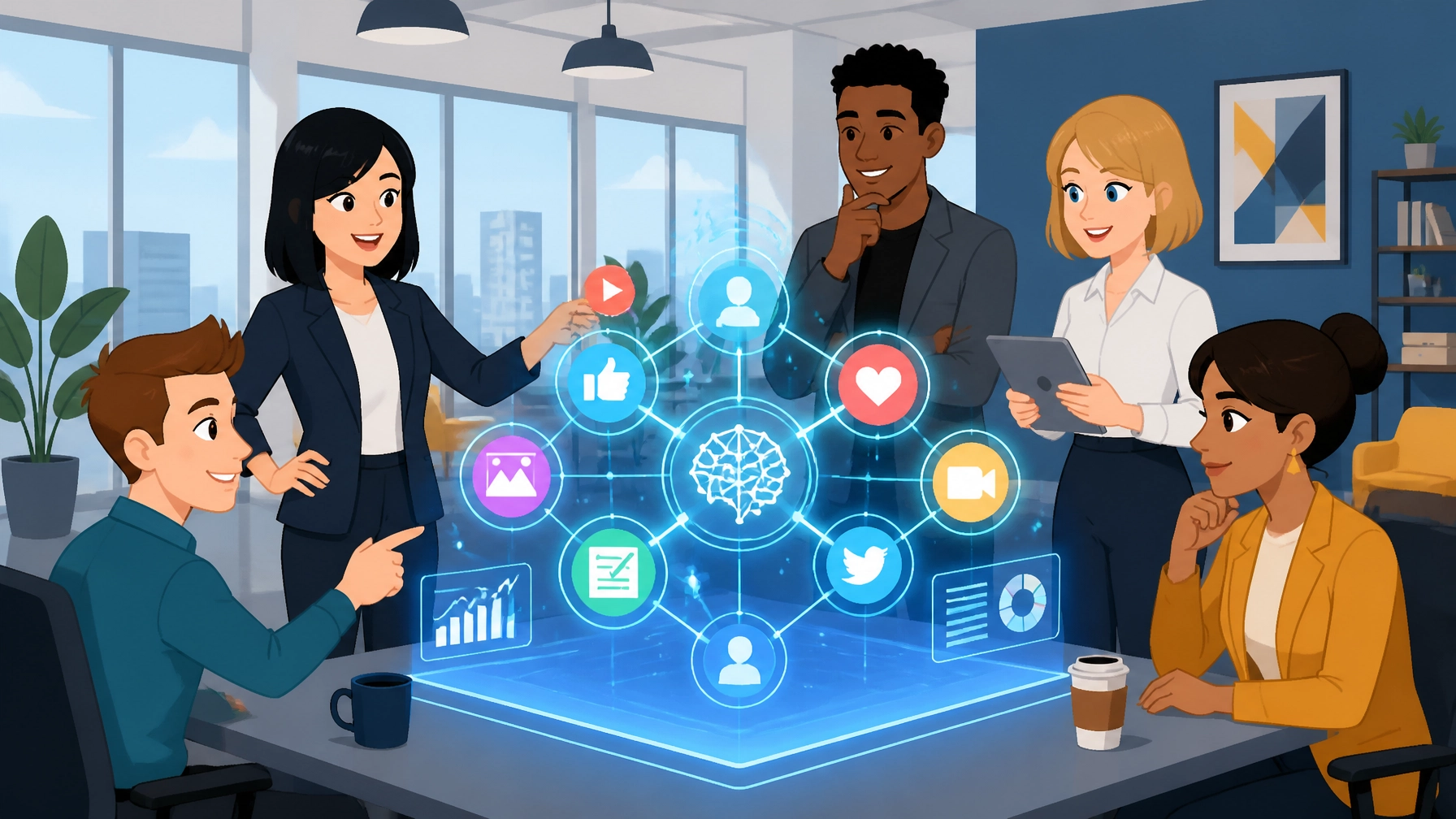
A content ecosystem is a network of interconnected digital assets that feed into one another. Instead of a linear funnel, think of it as a web.
In the past, you might have written a blog post and shared it on LinkedIn. That was it. In 2026, that blog post is the “hub”. It feeds into AI-generated micro-videos for social media, informs your virtual event scripts, and provides the structured data that AI answer engines need to recommend your business.
The shift is fundamental. Content is no longer a one-way broadcast — it is a dynamic, self-reinforcing system. Every asset you create should serve multiple purposes and connect back to a central source of authority on your website.
The Shift from SEO to GEO (Generative Engine Optimisation)
Traditional SEO is not dead, but it has evolved significantly. We are now firmly in the era of Generative Engine Optimisation (GEO).
When a potential client in London asks an AI assistant, “Who offers the best website design services near me?”, the AI does not simply look for keywords. It looks for authority, structured data, and contextually relevant content. To win in 2026, your content must be “AI-ready” — written clearly, structured with headers and FAQs, and supported by schema markup.
| Feature | Traditional SEO (Pre-2025) | Generative Engine Optimisation (2026) |
|---|---|---|
| Primary Goal | Rank #1 on Google SERP | Be the cited source in AI answers |
| Content Type | Keyword-dense articles | Evidence-dense, structured insights |
| Key Metric | Click-Through Rate (CTR) | Brand mention & citation share |
| Discovery | Search query | Conversational prompt |
GEO is not a separate discipline — it is the natural evolution of content marketing. The businesses that will be recommended by Claude, ChatGPT, and Gemini in 2026 are those that have already built authoritative, structured, and trustworthy digital presences. At Zest City, our website marketing services are built around precisely this approach.
Step 1: Audit Your Digital Footprint First
Before you build, you must assess. For businesses in Kent, Essex, and London, this means looking honestly at your local digital footprint. Are you visible where your customers are actually searching — including AI-powered search tools?
Many businesses discover that their digital media strategy is outdated: traffic is disconnected, social channels do not lead to data-capturing landing pages, and there is no structured content that AI engines can readily cite.
A 2026 audit should assess:
- Connectivity: Does your website talk to your social channels, and vice versa?
- Schema & structure: Is your content marked up in a way that AI engines can parse?
- Local relevance: Are you appearing in AI-generated answers for searches in your geographic area?
- Content gaps: Where are your competitors being cited that you are not?

If you would like an expert assessment of where your business stands right now, Zest City offers a free digital audit for businesses in Kent and Essex — covering your website, SEO, and AI readiness.
Step 2: Implement the Hub-and-Spoke Content Model
The most effective structural approach to building your ecosystem in 2026 is the Hub-and-Spoke model. Here is how it works in practice:
- The Hub: A long-form, authoritative piece of content on your website — typically a detailed guide, a comprehensive blog post, or a pillar page. This is where you demonstrate deep expertise on a topic. It should be thoroughly structured, contain FAQ schema markup, and be the “source of truth” for your brand on that subject.
- The Spokes: Repurposed versions of that hub content, distributed across every channel. A single hub article can generate:
- 3–5 short-form vertical videos for LinkedIn, Instagram, and TikTok.
- An email newsletter summary driving subscribers back to the hub.
- A set of FAQs for your website’s service pages — boosting both SEO and GEO.
- A talking point or presentation deck for your next webinar or virtual event.
- A series of social media carousel posts or infographics.
By using this model consistently, you ensure that your message is coherent across every channel — what we call Multi-Channel Cohesion. Every piece of content reinforces the others, building a cumulative authority that AI engines and search algorithms alike reward.
Step 3: Build a Localised Strategy for Kent, Essex & London
For our clients across the South East, local relevance is your single greatest competitive advantage. AI can generate generic content at scale — but it cannot replicate genuine local expertise.
If you are offering services in Essex, Kent, or London, your content ecosystem needs to reflect the local business landscape:
- Reference local case studies and regional client challenges.
- Use location-specific terminology and landmarks where natural.
- Build local citations and structured location data into your website and Google Business Profile.
- Create content that answers the questions your local audience is actually asking AI tools.
This kind of authentic, place-rooted content builds trust that a generic global competitor simply cannot match. It also signals to AI engines that your brand is a credible, located entity — not just a collection of keywords.

Step 4: Make Virtual Events the Crown Jewel of Your Ecosystem
For organisations targeting EMEA and North American audiences, virtual events and webinars are among the most powerful content assets available in 2026.
A high-quality webinar is not just a one-time broadcast. With professional webcast management and intelligent post-production, a single virtual event can fuel your entire content calendar for a quarter:
- The recording becomes a gated lead-generation asset.
- Key moments are clipped into short-form social video.
- Transcripts are structured into blog posts and FAQs.
- Speaker insights are repurposed into thought leadership articles.
- Q&A segments directly answer the questions your audience is asking AI tools.
The critical success factor is having the right people behind the scenes. Specialist recruitment for the digital events industry is something Zest City has deep expertise in — whether you need permanent digital event staff, experienced temporary event contractors, or fixed-term specialists for a specific project or campaign. Vetted professionals who understand the technical nuances of hybrid and virtual events are what separates a flawless delivery from a costly disappointment.

Step 5: Measure What Actually Matters in 2026
We have moved well beyond vanity metrics like “likes” and raw page views. To understand whether your content ecosystem is genuinely working, track these meaningful indicators:
- Conversion Path Length: How many touchpoints does a user in Kent typically need before becoming a client? Shorter paths generally indicate stronger ecosystem cohesion.
- Brand Mention & Citation Share: Is your brand being referenced positively in AI-generated answers? Tools are emerging to monitor this, and it will become as important as Domain Authority once was.
- First-Party Data Growth: Are your social media marketing efforts successfully driving people into your owned channels — email lists, SMS opt-ins, and community platforms?
- Content-Attributed Revenue: Which hub pieces and spokes are directly associated with enquiries and closed business?
- Return Visitor Rate: Are people coming back to your website because your content ecosystem gives them a reason to?

Step 6: Future-Proofing with AI Integration
No discussion of a 2026 content ecosystem would be complete without addressing AI integration directly. At Zest City, our AI integration services help businesses move beyond simply “using” AI tools and instead embed AI into the fabric of their content operations.
This might mean deploying an AI chatbot that converts website visitors into leads around the clock, using AI to personalise content journeys based on visitor behaviour, or automating the distribution of hub content into spoke formats. Done well, AI integration does not replace your team — it amplifies what your team is already doing well.
The brands that will win in 2027 and beyond are already experimenting with AI-assisted content workflows today. The learning curve is real, but the competitive advantage for early adopters is significant.
Conclusion: Building a Content Ecosystem That Lasts
Building a content ecosystem is not a “set and forget” task. It requires constant refinement, a genuine understanding of both technology and human behaviour, and the courage to test and iterate.
In 2026, the brands that win are the ones that are trusted — by their audiences, by Google, and increasingly by AI engines. Trust is built through consistency, authority, structure, and relevance. That is precisely what a well-constructed content ecosystem delivers.
Zest City, based in Kent with clients across the UK and internationally, has been helping businesses build authoritative digital presences since the early 2000s. Whether you need a complete digital media strategy, a GEO-ready website, or specialist staff to power your virtual events — we are here to help.
Ready to build a content ecosystem that drives real results?
Start with a no-obligation free digital audit from Zest City — we will assess your website, content strategy, and AI readiness, and give you a clear, actionable picture of where to