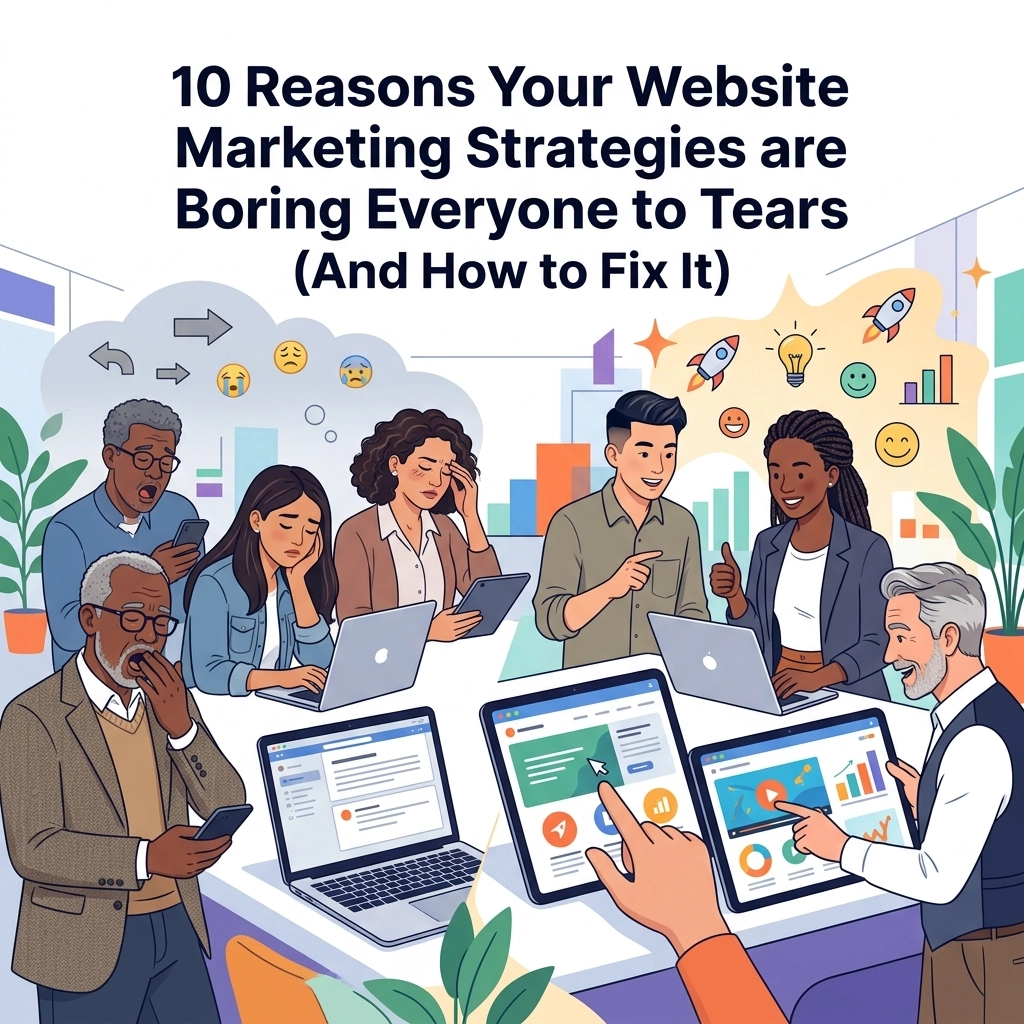
It is 2026. Artificial intelligence can predict your dinner cravings before you’ve felt a pang of hunger — and yet, walking through the digital front door of most businesses still feels like stepping into a beige-painted waiting room from 1994.
The internet has become a sea of sameness. Everyone is using the same large language models to write the same “thought leadership” posts, and the collective result is a yawn that echoes from London to Los Angeles. Your website marketing strategies might be technically “correct” according to a checklist written in 2022, but there is a strong chance they are boring your prospective clients to tears.
If your bounce rate is higher than a caffeine-fuelled kangaroo, it is time to face the music. Your marketing isn’t just invisible — it’s uninspiring.
Here are ten reasons why your strategy is failing the vibe check, and — more importantly — how to fix each one before it costs you another warm lead.
Zest City is a UK digital agency based in Kent and Essex, helping businesses across the country sharpen their website marketing strategies, redesign their digital presence, and build brands that actually get remembered. Everything below comes from hard-won experience working with real clients.
1. The “Default AI” Voice Is Killing Your Personality
In 2026, the single biggest mistake you can make is sounding like a robot. We can all spot it now: that perfectly polished, slightly repetitive, grammatically flawless but utterly soulless tone that has invaded every industry blog and LinkedIn feed.
When every brand sounds like a generic assistant, nobody stands out. You become wallpaper.
The Fix: Inject friction. Use “I” and “we.” Share a controversial opinion. Be human. If your copy doesn’t sound like something you’d say over a pint or a decent flat white, delete it and start again. Your brand voice is one of the few things AI genuinely cannot replicate — use it.

2. You’re Selling Features, Not Feelings
Nobody wakes up thinking, “I really need a 256-bit encrypted cloud-based synchronisation tool.” They think, “I want to stop losing files and looking like an idiot in front of my boss.”
Most website marketing strategies are obsessed with the “what” and the “how,” completely ignoring the “why.” Features are forgettable. Feelings are sticky.
The Fix: Map every feature to a human emotion. Don’t sell a faster website — sell the joy of a frustration-free afternoon. Don’t sell recruitment services — sell the relief of finally having a team that genuinely gets the brief. The language shift is small; the commercial impact is not.
3. Your Website Is a Static Monument, Not a Living Experience
If your website looks identical today to how it looked six months ago, you are quietly telling the world you have stopped growing. In the fast-moving world of digital, a static site is essentially a dead site.
The Fix: Embrace dynamic content. Showcase your latest case studies. Refresh your hero copy seasonally. Highlight your most recent social media marketing activity to signal to visitors — and to Google — that you are active, relevant, and operating in the current year. A website should be a living document, not a digital gravestone.
4. The Jargon Jungle Is Impenetrable
“Synergising omni-channel paradigms to leverage scalable growth.”
Do you know what that means? Neither do your customers. Corporate jargon is a linguistic shield used to disguise a lack of real substance. If you use it to sound smart, you typically end up sounding as though you’re trying too hard — and hiding something.
The Fix: Apply the Grandma Test. If you cannot explain your primary value proposition to your nan in two clear sentences, your website marketing strategy is too complex. Simplify until it hurts, then simplify once more.
5. You’re Ghosting Your Own Audience
You publish a blog post once every three months, send a newsletter when you remember, and reply to LinkedIn comments four days late. This inconsistency doesn’t just look unprofessional — it creates a sense of unreliability. If you can’t manage your own marketing calendar, why would a prospective client trust you with theirs?
The Fix: Create a drumbeat. It does not have to be daily, but it must be predictable. Consistency is the bedrock of trust. If you’re struggling to identify where your bottlenecks are, a free digital audit from Zest City is a practical first step to diagnosing the problem and building a plan that is actually sustainable.
6. Your UX Is a “Choose Your Own Adventure” Nightmare
We have all experienced it: a website where the “Contact Us” button is buried behind a hamburger menu, which is obscured by a pop-up, which is blocked by a cookie banner. If your visitor has to work hard to give you money, they won’t bother.
The Fix: Design for frictionless flow. Every page should have one clear, obvious goal. Reduce the number of clicks between “Hello” and “Hire Us.” Good professional website design should feel like a slide, not a staircase — effortless, logical, and satisfying.

7. You’re Ignoring the Micro-Moment
In 2026, attention spans aren’t just short — they are fragmented across a dozen surfaces simultaneously. People are not reading your 3,000-word whitepaper on the commute; they are skimming for the “aha!” moment while waiting for their oat latte.
The Fix: Structure your content as Bites, Snacks, and Meals.
- Bite: A punchy headline or a 15-second clip that earns the next five seconds of attention.
- Snack: A 200-word tip, a tight infographic, or a pull quote that delivers one clear insight.
- Meal: The deep-dive article, whitepaper, or case study for those who are genuinely ready to commit.
Always lead with the bite. The meal is only for those who’ve already decided they’re hungry.
8. Your Visuals Are Corporate Stock Photo Hell
If I see one more photograph of two people in matching suits shaking hands in front of a glass building, I cannot be held responsible for my reaction. Everyone — including your prospects — knows exactly what a stock photo looks like in 2026. It signals “we have no original ideas,” and that is a devastating first impression for a business asking to be trusted with someone’s brand.
The Fix: Use real photographs of real people. Commission custom illustrations. If you do use AI-generated imagery, make it genuinely distinctive rather than generic. At Zest City, we believe your corporate identity and visual brand should be as distinctive as your proposition — not borrowed from a subscription library.

9. You Forgot to Be Useful
Content marketing is fundamentally a trade. You give the reader genuinely useful information; they give you their attention and, eventually, their trust. If your “content” is merely a long-winded advertisement dressed up as an article, the trade is unfair and your audience will clock it immediately.
The Fix: Teach something. Solve a real, small problem for free. Give away the insight that your competitors are keeping behind a gated form. If you help someone for free, they are significantly more likely to pay you to solve their bigger problems. This is the essence of a sustainable digital media strategy — generosity that earns commercial returns over time.
10. You’ve Lost Your Edge
Perhaps the most common and most fatal mistake of all: at some point, likely when you were busy with client work, you stopped being interesting. You started playing it safe. You softened every opinion, hedged every claim, and rounded off every sharp corner until your brand became smooth, inoffensive, and completely forgettable.
The safest possible position in a crowded market is, paradoxically, the most dangerous one.
The Fix: Reclaim your point of view. What does your business actually believe? What would you say to a prospective client that a more cautious competitor wouldn’t dare put in writing? Find that sentence, and put it on your homepage. Polarisation is not a risk in 2026 — invisibility is.
Ready to Stop Being Invisible?
If two or more of the ten points above made you uncomfortable, that discomfort is data. It is telling you something needs to change.
Zest City is a Kent and Essex-based UK digital agency specialising in website marketing strategies, brand development, UX-led web design, and digital media — helping businesses across the UK move from forgettable to unmissable. We work with businesses of every size, from growing independents to established organisations that know they’ve gone stale and are ready to do something about it.
Claim your free digital audit today and let us show you exactly where your marketing is losing momentum — and how to get it back.
Or, if you already know what you need, explore our website marketing services and let’s get started.
Frequently Asked Questions: Website Marketing Strategies
What is a website marketing strategy and why does it matter in 2026?
A website marketing strategy is a planned approach to attracting, engaging, and converting visitors on your website using a combination of content, SEO, UX design, social media, and digital advertising. In 2026, it matters more than ever because organic attention is harder to earn — audiences are more sceptical, AI-generated content has flooded every channel, and the businesses that stand out are those with a genuinely distinctive voice and a clear reason for their audience to return.
How do I know if my website marketing strategy isn’t working?
Common warning signs include a high bounce rate (visitors leaving immediately), low average session duration, declining organic traffic, poor conversion rates from visitor to enquiry, and inconsistent or infrequent publishing. If your website feels more like a static brochure than an active marketing channel, that is a strong indicator your strategy needs refreshing. A free digital audit can give you a clear, objective picture of where the gaps are.
What is the most important element of a website marketing strategy?
Consistency and relevance are arguably the two most important pillars. Your strategy must deliver genuinely useful content to the right audience, at the right time, through the right channels — and it must do so reliably, not sporadically. Without a consistent publishing drumbeat, even excellent content fails to build the authority and trust that search engines and prospective clients reward.
How can small UK businesses