Right, let’s talk about marketing ops workflows in 2026. Not the fluffy theory stuff — the actual systems that keep campaigns running without everything catching fire every other Tuesday.
If you’re still manually copying data between platforms, chasing approvals through email chains, or wondering which version of that creative asset is the “final final FINAL” one, you’re working too hard. The marketing ops systems being built in 2026 are designed to be self-driving engines that connect every piece of your marketing puzzle automatically.
Here’s what that actually looks like in practice — and how Zest City, a UK digital agency specialising in web marketing, AI integration, and digital automation, approaches this for clients across Kent, Essex, and beyond.
The Four Pillars You Can’t Skip
Every marketing ops workflow that actually works is built on four foundations: people, process, technology, and data. Miss one, and the whole thing wobbles.
People means knowing who does what, when they’re available, and what they’re brilliant at. Your workflow should automatically route design requests to designers who aren’t drowning, not just the first person on the list.
Process is your playbook. It’s the standardised steps that turn a campaign brief into a live campaign without seventeen Slack messages asking “what happens next?”
Technology is the platform layer that connects everything. In 2026, that means tools that actually talk to each other without needing a developer to build custom integrations every time.
Data is the feedback loop. Your workflow needs to capture what’s happening, measure what matters, and surface insights without someone manually building reports in spreadsheets at 11pm.
When these four work together, you get workflows that scale. When they don’t, you get chaos with expensive software licences.

The Core Workflow Stages (That Actually Matter)
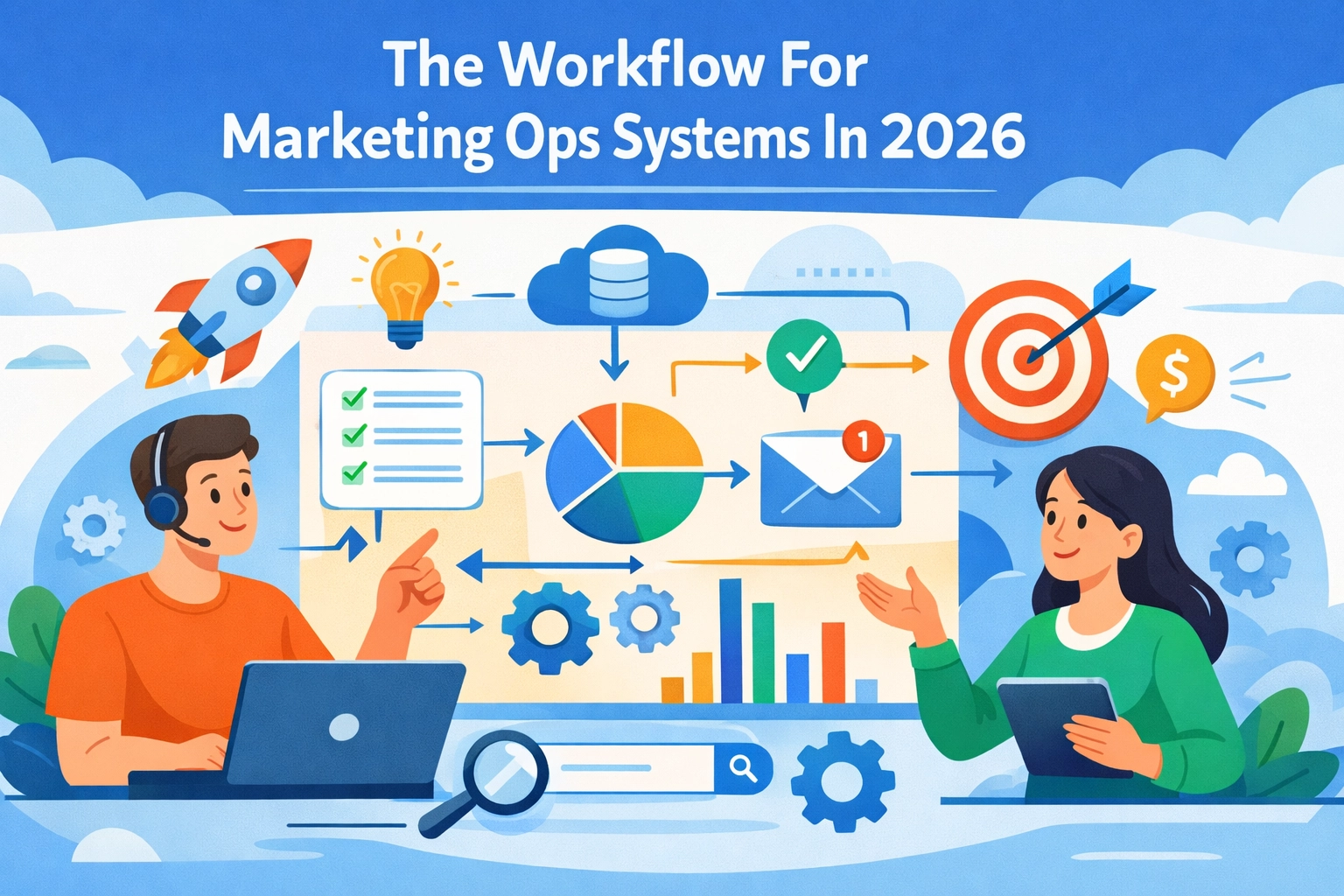
Here’s how a typical marketing campaign flows through a 2026 ops system:
1. Request Intake
Everything starts with a proper brief. Use forms that capture what you actually need to know — not 47 fields that nobody fills in properly. The system routes this to the right team based on campaign type, urgency, and current capacity.
2. Approval Routing
Legal sign-offs, budget approvals, executive reviews — these happen automatically based on campaign value and risk. No more “sorry, didn’t see your email” holding up launches. The system knows who needs to approve what, sends reminders, and escalates when things stall.
3. Creative Production
Requests land in the right designer’s queue based on skills and workload. They’ve got access to approved brand assets, previous campaign templates, and AI tools that handle the tedious bits. When it’s done, it moves to review automatically.
4. Campaign Execution
This is where the magic happens. Your workflow orchestrates email, SMS, social, push notifications, and whatever other channels you’re using. AI handles personalisation at scale, A/B testing runs automatically, and the system adapts based on early performance signals.
5. Performance Analysis
The moment your campaign wraps, insights start generating. No waiting for someone to pull the numbers. Your dashboard shows what worked, what flopped, and what to do differently next time — feeding straight back into your next campaign brief.
The beauty of this setup? Once it’s running, your team focuses on strategy and creativity instead of project management busywork.
Automation That Actually Works
Let’s be honest: automation has been overpromised for years. In 2026, it finally delivers.
The difference is unified automation that spans your entire workflow, not just isolated bits. You’re not automating email sends while manually tracking approvals in spreadsheets. Everything flows.

Think about it: a campaign brief submitted at 9am can trigger automatic budget checks, route to the right creative team, generate first-draft copy using AI, schedule approval reviews, and have preliminary campaign builds ready by lunchtime — no human intervention required for the mechanical stuff.
The time savings are real. Teams are consistently hitting 30% reductions in repetitive task time, which means more hours for the work that actually moves the needle: strategy, testing, optimisation, and creative thinking.
Building this doesn’t require an army of developers. Modern platforms use visual workflow builders where you drag and drop the steps. Need to add a new approval stage? Five minutes. Want to change how leads get scored and routed? Done before your coffee gets cold.
The key is designing workflows that reflect how your team actually works, not forcing everyone into some rigid template. If you’re curious how AI-powered automation could fit into your existing stack, Zest City’s AI integration services are a sensible starting point.
Breaking Down the Silos
Here’s where things get interesting. Marketing ops in 2026 isn’t just about marketing anymore.
Your workflow connects marketing, sales, product, and leadership through shared workspaces where everyone sees the same data, works from the same definitions, and aligns around the same goals.
- Lead scoring? Sales and marketing define it together in the system.
- Campaign performance? Product teams see which features are resonating.
- Budget and ROI? Leadership has real-time dashboards instead of waiting for quarterly reports.
This matters because campaigns don’t exist in isolation. A product launch needs sales enablement, customer success briefings, and product updates — all coordinated through one workflow instead of separate tools that don’t talk to each other.
Integration with tools your teams already use (Slack, Microsoft Teams, your CRM) means communication stays contextual. No more “can someone update me on this campaign” messages. The system keeps everyone informed automatically.
At Zest City, we’ve seen this transform how teams operate. When everyone’s working from the same system, decisions happen faster and campaigns launch cleaner. It’s a core principle behind how we approach website marketing services for our clients — joined-up thinking from brief to results.

The Product Mindset Shift
The best marketing ops teams in 2026 aren’t running ticket queues. They’re running internal product teams.
What’s the difference? Instead of reactively responding to campaign requests, you’re building scalable frameworks that anyone can use:
- Onboarding flows for new product launches
- Campaign templates for recurring programmes
- Automated QA checklists that catch issues before launch
- Modular tech stacks that plug together cleanly
You run sprints, maintain roadmaps, and treat your internal processes as a product that needs continuous improvement — not a static set of instructions gathering dust in a shared drive.
This shift is what separates marketing ops teams that scale from those that burn out. It’s also why investing in proper digital strategy and media planning as a foundation pays dividends as your ops capability matures.
What Good Marketing Ops Technology Looks Like in 2026
The platform landscape has matured significantly. Here’s what a well-configured marketing ops tech stack typically includes:
- A central campaign management hub — the single source of truth for all campaigns, briefs, assets, and approvals
- Native AI tools — for copy generation, audience segmentation, predictive analytics, and content personalisation
- Two-way CRM integration — so marketing and sales are always working from the same customer data
- Asset management with version control — no more “final_v3_ACTUALFINAL.pdf” in your shared drive
- Real-time performance dashboards — that update automatically rather than requiring manual exports
- Compliance and approval workflows — particularly important in regulated industries
The goal isn’t to use the most tools — it’s to use the right tools that genuinely connect. Fewer, better-integrated platforms consistently outperform sprawling stacks that create their own data silos.
If your website and digital presence aren’t yet pulling their weight within this ecosystem, it’s worth reviewing the fundamentals. A well-structured site built for performance is the bedrock everything else plugs into — which is precisely why Zest City’s website design services are built with marketing integration in mind from day one.
Common Pitfalls (And How to Avoid Them)
Even well-funded marketing ops programmes stumble. Here are the most common reasons — and how to sidestep them:
- Automating broken processes. Automation makes bad processes faster and more expensive. Map and fix your process first, then automate it.
- Buying tools before defining outcomes. Start with “what problem are we solving?” — not “what software looks impressive?”
- Neglecting change management. The best workflow system in the world fails if your team doesn’t adopt it. Training and buy-in are not optional extras.
- Treating data as an afterthought. If your data isn’t clean and consistent going in, your insights coming out will be worthless.
- Over-engineering from day one. Start with the simplest version that works, then iterate. Complexity is earned, not assumed.
How Zest City Helps Businesses Build Smarter Marketing Systems
Zest City is a UK digital agency based in Kent and Essex, working with businesses across the UK to design, build, and optimise their digital marketing infrastructure. From AI-powered automation and chatbot integration to joined-up website marketing strategy, we help marketing teams move from reactive firefighting to proactive, data-driven campaigns.
Whether you’re starting from scratch or untangling an overcomplicated existing stack, we take a practical, no-nonsense approach — focused on what actually moves the needle for your business.
Ready to see what a smarter marketing ops setup could look like for you? Book your free digital audit and we’ll give you an honest assessment of where your biggest opportunities lie.
Frequently Asked Questions: Marketing Ops Workflow Systems
What is a marketing ops workflow system?
A marketing ops workflow system is a structured set of processes, tools, and automations that manage how marketing campaigns are planned, produced, approved, executed, and analysed. Rather than relying on ad-hoc emails and manual handoffs, a workflow system routes tasks automatically, tracks progress in real time, and connects every stage of the campaign lifecycle in one place.
What are the four pillars of marketing operations?
The four pillars of marketing operations are people, process, technology, and data. People covers team roles and capacity; process provides the standardised steps campaigns follow; technology is the platform layer that connects and automates those steps; and data supplies the feedback loop that measures performance and informs future decisions. Effective marketing ops requires all four working in alignment.
How does AI fit into marketing ops workflows in 2026?
In 2026, AI is embedded throughout the marketing ops workflow rather than bolted on as a standalone tool. It handles tasks such as first-draft copy generation, audience segmentation, lead scoring, predictive performance modelling, and campaign personalisation at scale. The practical result is that marketing teams spend less time on mechanical work and more time on strategy and creative direction.
How long does it take to build a marketing ops workflow system?
A basic, functional workflow system can be set up within a few weeks using modern no-code and low-code platforms. A more comprehensive system — integrating CRM, asset management, AI tools, and cross-team dashboards — typically takes two to four months, depending on the complexity of your existing tech stack and how much process documentation already exists. Starting simple and iterating is almost always more effective than attempting a full build